
Cutting corners on traffic control looks cheap until something goes wrong. For project managers and site supervisors weighing up their options, hiring accredited traffic controllers saves money in ways that aren’t always obvious at the quoting stage but become very clear, very quickly, once you’re on site.
The real cost comparison is straightforward once you look past the initial quote.
Compliance Failures Are Expensive. Accreditation Is Not.
In Queensland, every person directing traffic on a worksite must hold a current Industry Authority card issued under the Traffic Controller Accreditation Scheme (TCAS), administered by Transport and Main Roads (TMR). In New South Wales, Transport for NSW (TfNSW) sets equivalent requirements. Putting an unaccredited worker in a stop/slow bat role isn’t a grey area. It’s a regulatory breach, and the consequences are measurable.
WorkCover investigations happen. Site shutdowns happen. Infringement notices follow. A half-day shutdown on a civil works corridor can cost a principal contractor tens of thousands of dollars in idle plant, crew time, and schedule compression. That’s before any legal exposure if an incident occurs and it comes out that the person directing traffic wasn’t qualified to do so.
Accredited Traffic Controllers (TCs) have completed three nationally recognised units, including RIIWHS205E (Control traffic with a stop/slow bat), and have logged 20 hours of supervised practical placement before receiving their card. That training exists because directing traffic on live roads is a safety-critical task. The accreditation cost is a fraction of the cost of a single compliance failure.
Productivity You Can Actually Measure
An accredited TC doesn’t just hold a bat. They read traffic flow, communicate with other controllers across a site, and make real-time decisions that keep vehicles and workers moving safely. That competency directly affects how efficiently a worksite runs.
Consider a two-lane road closure on a regional highway. A trained TC manages the stop/slow sequence, coordinates with the far end of the closure, and adjusts for unexpected traffic surges, including heavy vehicles that need additional clearance time. Get that wrong and you get queues backing up past safe sight distances, frustrated drivers making poor decisions, and a foreman spending time managing traffic problems instead of managing the job.
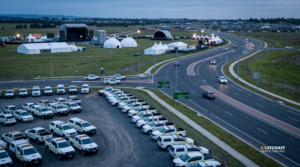
ECTC crews operating out of depots like Townsville, Rockhampton, and Hervey Bay work regularly on regional highway corridors where traffic conditions change fast. The difference between a controller who knows what they’re doing and one who doesn’t shows up in the site diary before the end of the first shift.
For larger projects, Traffic Management Implementers (TMIs) take responsibility for setting out and supervising Traffic Guidance Schemes (TGSs). Having that expertise on site means the Traffic Management Plan (TMP) is being implemented correctly, not interpreted loosely by someone who read it once on the way to the job.
The Hidden Costs of Getting It Wrong
Insurance, liability, and incident investigation costs rarely appear in a traffic control quote comparison. They should.
When an unaccredited worker is involved in a traffic-related incident, the liability question becomes complicated fast. Insurers scrutinise whether the principal contractor met their duty of care in selecting competent personnel. If the answer is no, indemnity can be reduced or voided. The principal wears the cost.
There’s also the reputational dimension. Government clients and major tier-one contractors run compliance audits. ECTC works with clients including TMR, Aurizon, and Durkin Construction on projects where documentation of accreditation, currency of cards, and adherence to MUTCD Part 3, Works on Roads is non-negotiable. If your traffic control provider can’t produce current credentials on request, you’re the one answering for it.
ECTC is ISO certified across quality, safety, and environmental management. That’s not a badge for the website. It’s an auditable system that gives clients a defensible paper trail when things are reviewed after the fact.
What Accredited Traffic Control Actually Costs
Professional, accredited traffic control is priced competitively when you factor in what you’re actually buying.
Pay for accredited TCs sits at or above the award rate under the Building and Construction General On-site Award, with penalty rates applying for night shifts, weekends, and public holidays. There’s also a travel allowance of around $20 per day for regional work. That’s the baseline, and it’s appropriate for the risk and responsibility the role carries.
What you’re not paying for, when you use a provider like ECTC, is the downstream cost of a compliance breach, a WorkCover investigation, a project delay, or an insurance dispute. You’re also not paying for the productivity loss that comes from putting the wrong person in a safety-critical role.
ECTC has operated since 1993. Over three decades, the business has been built on one principle: doing traffic control properly is always cheaper than doing it twice, or defending it in court. That’s not a marketing line. It’s what 33 years of operating on Queensland and New South Wales worksites teaches you.
If you’re planning a project and want traffic control that holds up under scrutiny, call ECTC on 1300 011 203 or email sales@ectc.com.au. We’ll give you a straight answer on what your site needs and what it’ll cost.