Most event organisers think about traffic last. By then, the road network around the venue is locked in, the council deadline is closing fast, and the TMP gets rushed. That’s where it falls apart. A well-built special event traffic management plan keeps pedestrians safe, keeps traffic moving, and keeps your event permit on track.
At East Coast Traffic Control, we’ve been building event TMPs since 1993. Community festivals on the Sunshine Coast. Major infrastructure corridor events in regional Queensland and New South Wales. The scale changes but the discipline doesn’t.
What Makes an Event TMP Different from a Roadworks TMP
Roadworks TMPs are built around predictable conditions. You know the work zone. You know the duration. Event traffic is different. Less predictable. Often compressed into tight windows.
A community festival in Maroochydore might draw 3,000 people over a weekend. A regional agricultural show in Rockhampton might see 15,000 attendees arrive and leave within a few hours. Both need a TMP. The complexity is completely different.
Event TMPs have to account for pedestrian volumes crossing live traffic lanes and temporary changes to parking and access routes. Public transport integration where it exists. Crowd behaviour that doesn’t follow commuter patterns. They also need to align with state requirements and local council conditions of approval.
In Queensland, temporary traffic management for events sits under MUTCD Part 3, Works on Roads, published by Transport and Main Roads. In New South Wales, Transport for NSW governs the requirements. Both states align to the Austroads Guide to Temporary Traffic Management, which was last updated in March 2025. Getting the regulatory layer right from the start saves significant rework later.
How We Scale a TMP to the Event
Crowd size is the obvious starting point. Road classification matters enormously. Managing pedestrian crossings on a local street is different to managing ingress and egress on a state-controlled road. The latter involves TMR or TfNSW directly, and the approval pathway is longer.
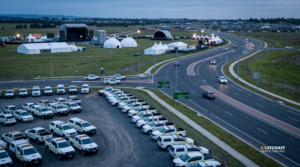
For smaller community events, a TMP might involve a single Traffic Guidance Scheme covering a road closure or a pedestrian crossing point, with a small crew of accredited Traffic Controllers on the ground. For larger events, we’re looking at multiple TGSs, staggered crew shifts, and Truck-Mounted Attenuator deployment on adjacent high-speed roads. Coordination with police and emergency services is built in.
The crew tier scales with the job. Traffic Controllers hold their Industry Authority card under the Traffic Controller Accreditation Scheme and manage ground-level traffic direction. Traffic Management Implementers set out and supervise Traffic Guidance Schemes on site. Traffic Management Designers prepare the TMPs and TGSs. ECTC has all three tiers in-house. The plan that gets submitted to council is the same plan our crew implements on the day. No gap between the document and the delivery.
TMA accreditation matters for events near high-speed corridors. Not every traffic management company holds it. We do.
What Councils and Road Authorities Actually Want to See
Council requirements vary. Common threads exist. Most councils want a TMP submitted 20 to 30 business days before the event. The document needs to show that pedestrian safety has been considered at every decision point. Emergency vehicle access must be maintained throughout. Traffic Guidance Schemes need to be drawn to the correct standard.
Road authorities want to see qualified people signing off on the plan. A TMP prepared by a Traffic Management Designer and implemented by accredited TMIs carries weight. A plan prepared by someone without formal TMD qualifications is a risk the organiser carries.
We work with councils across Queensland and New South Wales regularly, including local government clients like Hilltops Council in NSW. The approval process is smoother when the TMP is complete on first submission. Incomplete documents, missing TGS drawings, or plans that don’t address pedestrian volumes are the most common reasons for delays.
If your event is on or adjacent to a state-controlled road in Queensland, you’ll need TMR involvement regardless of whether the council is your primary approving authority. That layer is non-negotiable and needs to be built into your timeline.
Planning Ahead Saves the Event
The events that go smoothly are the ones where the TMP process started early. We’ve seen organisers come to us six weeks out with a workable brief. We’ve also seen organisers come to us six days out expecting the same result. The second scenario creates risk for everyone.
Our depots across Queensland and New South Wales mean we can resource events regionally without importing crews from the coast. A music festival near Coffs Harbour. A show event near Cairns. A community function on the Gold Coast. Local crews know the road network and the local council expectations.
If you’re planning an event and haven’t started the TMP process yet, start now. The later it gets, the fewer options you have.
Contact East Coast Traffic Control on 1300 011 203 or email sales@ectc.com.au to talk through your event requirements. We’ll tell you what’s needed, how long it takes, and what it costs. No runaround.