
Queensland’s infrastructure pipeline is bigger than it’s been in a generation, and traffic control jobs are at the centre of it. If you’re working in the industry or thinking about getting your Industry Authority card, understanding where things are heading isn’t just useful. It’s essential for making smart decisions about your career.
The Infrastructure Spend Is Real, and It’s Creating Sustained Demand
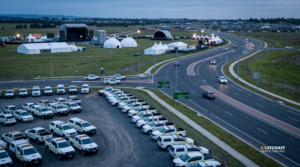
The numbers speak for themselves. The $1.98 billion Rockhampton Ring Road ($1.4 billion Commonwealth, $580 million Queensland) is one of the most significant road projects the state has seen in years. Queensland’s $511.5 million Road Safety Initiative is rolling out works across the state. The Bundaberg-Miriam Vale Road Safety Works are adding traffic control requirements across a long stretch of the Bruce Highway corridor.
These aren’t short-term projects that wrap up in six months. They run for years. They require accredited Traffic Controllers on site every single day. That’s not a prediction. That’s what’s happening right now in regional Queensland.
What this means for traffic control jobs is straightforward: sustained demand, particularly in regional areas. Rockhampton, Mackay, Townsville, Gladstone, Hervey Bay. These are where the work is concentrated. Experienced TCs are genuinely hard to find in these regions.
AGTTM Harmonisation Is Raising the Bar Across the Board
The March 2025 update to the Austroads Guide to Temporary Traffic Management brought Queensland and New South Wales closer together in how they regulate temporary traffic management on worksites. For workers, this matters.
Harmonisation doesn’t mean your Queensland TCAS accreditation transfers interstate. It doesn’t. Each state runs its own scheme. Queensland sits under the Traffic Controller Accreditation Scheme administered by Transport and Main Roads. New South Wales operates under Transport for NSW. They’re separate, and mutual recognition between states doesn’t apply.
What harmonisation does mean is that the technical standards converge. Traffic Guidance Schemes. Signage requirements. Risk assessment frameworks. That raises the baseline expectation for every accredited TC on site. Knowing your three core units (RIIWHS205E, RIIWHS201E, and RIICOM201E) is the floor, not the ceiling.
The practical implication: employers and principal contractors are getting more rigorous about compliance. A TC who understands MUTCD Part 3, Works on Roads and can apply it confidently on site is far more employable than one who’s just done the minimum to get the card. That gap in capability is only going to widen.
Regional Roles Are Where the Real Opportunity Sits
Traffic control work isn’t just a coastal or city-based industry. Some of the most consistent, well-paying work in Queensland right now is in the regions.
The Clarke Creek Wind Farm and Solar project in Central Queensland is a good example. Remote. Large-scale. Long-duration. Projects like that require not just Traffic Controllers but Traffic Management Implementers who can set out and supervise Traffic Guidance Schemes across complex, high-speed environments. TMA-accredited crews, who operate Truck-Mounted Attenuators on high-speed road corridors, are in particularly short supply.
At East Coast Traffic Control, our depots in Rockhampton, Townsville, Mackay, Gladstone, and Hervey Bay aren’t satellite offices. They’re full operational bases with local crews who know the roads, the conditions, and the communities they work in. Local knowledge matters on a job site. It matters even more when you’re working through a North Queensland wet season or managing traffic around a regional event.
The pay structure reflects the demand. Traffic control work sits under the Building and Construction General On-site Award, with penalty rates for nights, weekends, and public holidays. Travel allowances of around $20 per day are standard. Most regional roles come with additional site-specific entitlements. For experienced TCs willing to work where the projects are, the earning potential is solid.
What This Means If You’re Thinking About a Career in Traffic Control
The pathway into Queensland traffic control is structured. You need a White Card (CPCWHS1001) before you can enter the Traffic Controller Accreditation Scheme. From there, you complete three nationally recognised units through a TMR-approved Registered Training Organisation, along with 20 hours of supervised practical placement. Your Industry Authority card is issued for three years, with refresher training required to renew.
First aid certification is a requirement for most site roles, including at ECTC. That’s an employer and industry requirement, not a TMR regulatory one, but treat it as non-negotiable if you’re serious about working in the field.
The TC tier gets you on the tools. The TMI tier (RIIWHS302E) opens up supervisory and more complex site roles. The TMD tier, Traffic Management Designer, is where planning and design work sits. Each step broadens what you can do and what you’re worth to an employer.
East Coast Traffic Control has been operating since 1993. Over 33 years, we’ve seen the industry change significantly. The crews who’ve built lasting careers in traffic control are the ones who kept their accreditation current, invested in moving up the tiers, and were willing to go where the work was. That formula hasn’t changed.
If you’re accredited and looking for consistent work across Queensland or New South Wales, or if you’re partway through the TCAS pathway and want to understand what practical placement looks like with an established operator, get in touch with the team at East Coast Traffic Control. Call us on 1300 011 203 or email sales@ectc.com.au to talk through what’s available.